


-
生物通官微
陪你抓住生命科技
跳动的脉搏
一种针对引起尿路感染的细菌的可能疫苗
【字体: 大 中 小 】 时间:2022年11月29日 来源:Science Advances
编辑推荐:
杜克大学的一个研究团队开发了一种针对尿致病性大肠杆菌(UPEC)的疫苗,UPEC是导致人类尿路感染(UTIs)的细菌类型。
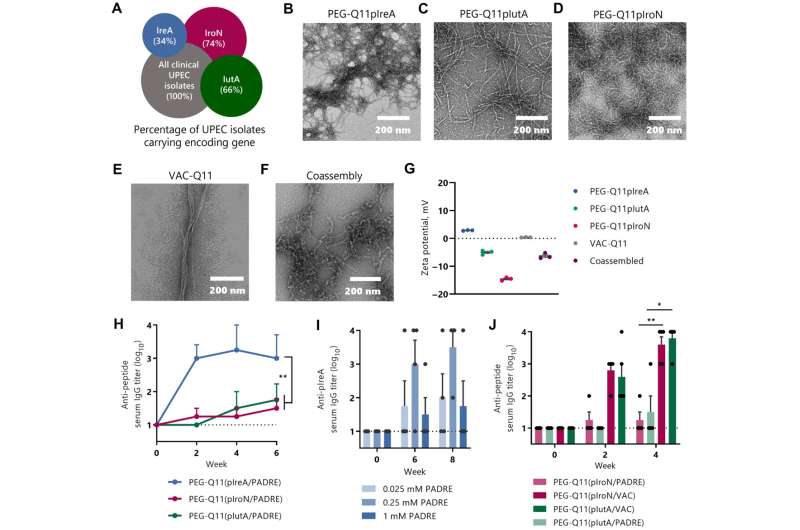
![Sublingual nanofiber vaccine raises antibody responses against three B cell epitopes with broad expression across UPEC strains.(<b>A</b>) Percentage of clinical UPEC isolates that contain the gene encoding the parent proteins of the pIroN, pIutA, and pIreA epitopes (<i>2</i>). Transmission electron microscopy images of nanofibers composed of (<b>B</b>) PEG-Q11pIreA, (<b>C</b>) PEG-Q11pIutA, (<b>D</b>) PEG-Q11pIroN, and (<b>E</b>) VAC-Q11, or (<b>F</b>) a coassembly of these four together. (<b>G</b>) Zeta potential measurements of nanofiber assemblies. (<b>H</b>) Mice were immunized sublingually with coassembled PEG-Q11 nanofibers containing the PADRE T helper epitope and either pIreA, pIroN, or pIutA B cell epitope, plus cholera toxin B (CTB) adjuvant. Mice were boosted at weeks 1 and 3, and serum immunoglobulin G (IgG) titer against the immunizing epitope was measured [two-way repeated-measures analysis of variance (RM-ANOVA), Tukey’s test, <i>n</i> = 4 per group]. (<b>I</b>) Effects of titrating T cell epitope content with sublingual nanofiber vaccines. Mice were immunized sublingually with PEG-Q11(pIreA/PADRE) nanofibers containing variable concentrations of PADRE plus CTB and were boosted at weeks 1, 3, and 6 (<i>n</i> = 4 per group). (<b>J</b>) Coassembly with the VAC epitope, but not PADRE, elicits antibody responses against pIutA and pIroN. Mice immunized with the pIutA or pIroN epitope and VAC are compared to responses with PADRE shown in (F). All mice were boosted at weeks 1 and 3, and formulations contained CTB adjuvant (two-way RM-ANOVA, Tukey’s test, <i>n</i> = 4 per group). Credit: <i>Science Advances</i> (2022). DOI: 10.1126/sciadv.abq4120 A possible vaccine against the bacteria that cause UTIs](/Editor/ebioueditorasp/asp/upload/image/20221128/16696082103092451.jpg)
杜克大学的一个研究团队开发了一种针对尿致病性大肠杆菌(UPEC)的疫苗,UPEC是导致人类尿路感染(UTIs)的细菌类型。在他们发表在《Science Advances》杂志上的论文中,该小组描述了他们如何制造疫苗,以及在小鼠和兔子身上测试时的表现。
尿路感染在女性中最常见,会在排尿过程中产生极度疼痛——它们还会导致其他并发症,如果不治疗,可能会致命。这种感染通常用抗生素治疗。不幸的是,一些女性会患上慢性感染,这意味着她们一年要经历几次尿路感染。
在这种情况下,继续开抗生素就成问题了,因为抗生素会杀死肠道内的所有细菌,这往往会导致其他肠道问题。在这项新的努力中,研究人员采用了一种新的方法来治疗尿路感染,即总体上避免使用抗生素,而是开发一种只针对感染背后细菌的药物。
多年来,科学家们一直在尝试研制UTIs疫苗,但均以失败告终,主要原因是药物无法穿透覆盖在口腔、喉咙和尿道壁上的细胞粘膜。为了克服这个问题,研究人员尝试了多种方法,包括操纵能够穿透细胞粘膜的药物。
他们开发了一种肽纳米纤维,它不仅可以穿透粘膜,还可以训练免疫系统识别和对抗UPEC,方法是将UPEC暴露在细菌表面的三种多肽上。由于尿道粘膜和口腔粘膜之间的相似性,疫苗输送方法被发现能在尿路中引起免疫反应。该团队发明的药片是在舌头下服用,并在唾液中溶解。
在鼠和兔子身上测试他们的疫苗时,研究人员发现它和传统抗生素一样有效,并确定重复使用它不会导致肠胃问题。如果这种疫苗被证明对人类有效,它将大大减少用于治疗疾病的抗生素数量,减缓细菌对现有抗生素的耐药性发展。
生物通微信公众号
知名企业招聘