

-

生物通官微
陪你抓住生命科技
跳动的脉搏
生物通官微
陪你抓住生命科技
跳动的脉搏
【Plant Communications】我校棉花遗传改良团队揭示GhFLA9_D12影响棉花纤维发育和衣分的分子机制
【字体: 大 中 小 】 时间:2026年10月10日 来源:华中农业大学植物科学技术学院
编辑推荐:
近日,华中农业大学作物遗传改良全国重点实验室林忠旭教授课题组研究成果以“Natural Variations in GhFLA9_D12 Confer Divergent Fiber Development and Lint Percentage via Cell Wall Plasticity Remodeling in Cotton”为题在Plant Communications发表
南湖新闻网讯(通讯员 李元雪)棉花作为全球重要的天然纺织原料,其产量与品质关系到纺织产业链的发展。衣分(Lint percentage,LP)即籽棉中可收获纤维的重量占比,是衡量棉花产量和经济效益的关键指标。近年来,得益于测序与分子标记技术的飞速发展,众多与衣分相关的数量性状位点(Quantitative Trait Loci,QTL)被相继鉴定,但其背后的精细分子调控网络仍有待解析。此外,棉纤维的发育伴随着细胞壁组分的动态变化与结构重塑,细胞壁蛋白作为细胞壁的重要组成部分,其自然变异蕴含着改变细胞壁特性的巨大潜力。因此,解析细胞壁蛋白自然变异及其调控细胞壁重塑的底层分子机制,将为协同改良棉花产量与品质提供全新视角。
近日,华中农业大学作物遗传改良全国重点实验室林忠旭教授课题组研究成果以“Natural Variations in GhFLA9_D12 Confer Divergent Fiber Development and Lint Percentage via Cell Wall Plasticity Remodeling in Cotton”为题在Plant Communications发表。研究解析了类成束阿拉伯半乳糖蛋白GhFLA9_D12自然变异如何通过精细调控细胞壁可塑性来决定棉花衣分的分子机制。
研究人员发现,自然群体中,GhFLA9_D12基因区域存在丰富遗传多态性,启动子区域162 bp Indel与编码区SNP连锁,将群体划分成两种单倍型HapA(T/INS)和HapB(C/DEL),其中携带HapA优势单倍型棉花衣分更高。进一步研究发现,GhFLA9_D12在纤维发育的各阶段优势表达,超量表达GhFLA9R显著提高衣分与纤维强度,增加成熟纤维细胞壁厚度与纤维素含量。GhFLA9_D12蛋白可与木聚糖、β-葡聚糖、果胶、甘露聚糖、木葡聚糖结合。转录组数据表明,差异表达基因显著富集于细胞壁多糖生物合成与重构过程,以及相关物质的跨膜转运活动。
编码区单个SNP引起的氨基酸变异导致GhFLA9R和GhFLA9G对细胞壁多糖的结合偏好不同,两种编码区类型的超量表达材料衣分均显著高于野生型,纤维强度及细胞壁厚度呈现相反的趋势。CArG-box元件在两种基因型启动子中的数目差异导致了上游转录因子GhAGL11的差异结合。proIn:FLA9R株系衣分显著高于proDel:FLA9R株系,表明GhFLA9_D12启动子中的天然Indel影响其表达水平及对纤维发育的功能贡献。脯氨酸羟化酶GhP4H和半乳糖基转移酶GhGalT1分别与GhFLA9_D12互作,二者在纤维发育的多个时期优势表达,其遗传转化材料与野生型相比,纤维品质显著改变,说明GhP4H和GhGalT1影响细胞壁重构与棉花纤维发育。
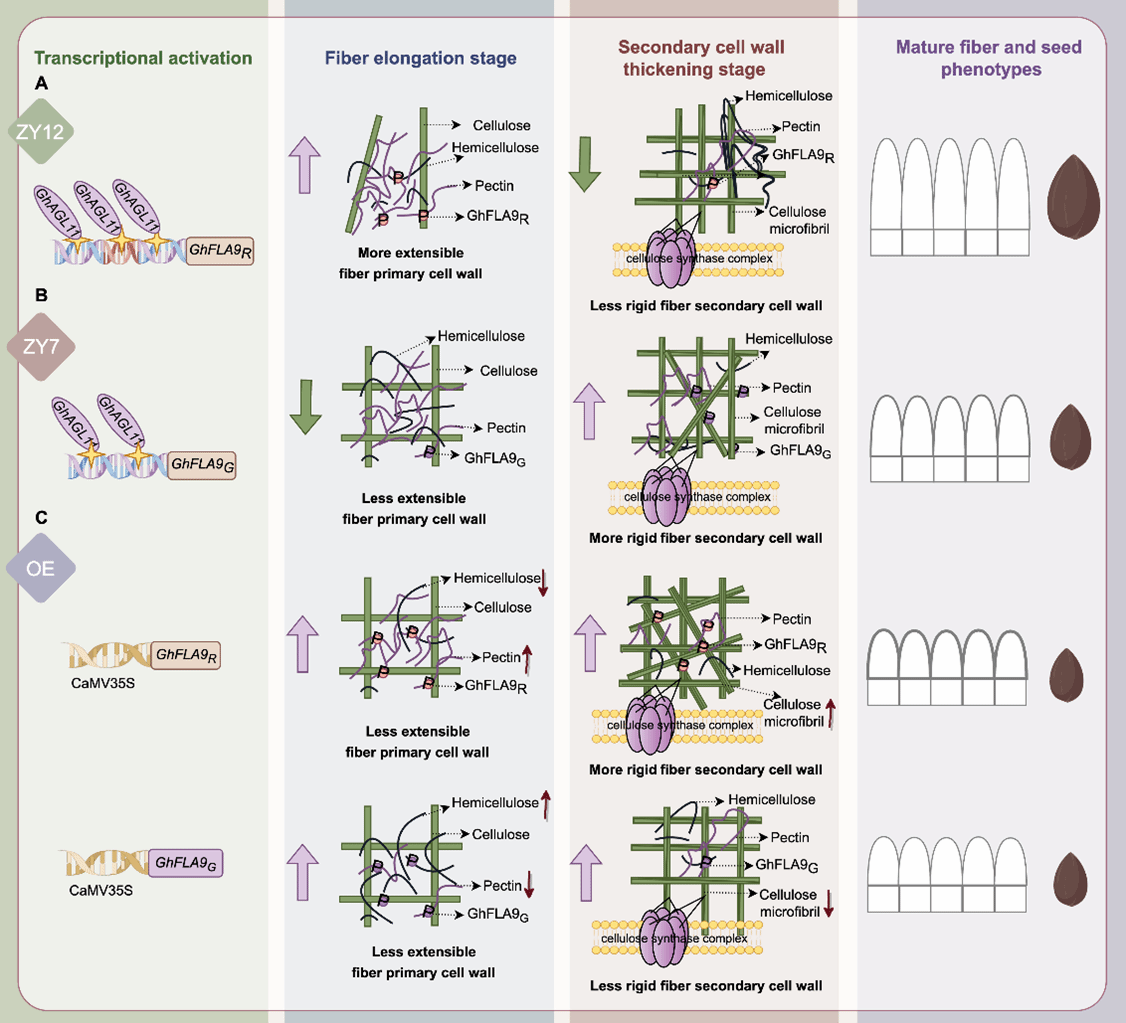
GhFLA9_D12自然变异调控棉花衣分的工作模型示意图
综上所述,该研究解析了GhFLA9_D12基因的自然变异到多层级调控细胞壁可塑性及棉花衣分的分子调控机理。研究成果不仅丰富了植物细胞壁与棉纤维发育的理论基础,更为棉花细胞壁性状的定向改良及高产优质品种培育提供关键的基因靶点。
华中农业大学植物科学技术学院已毕业博士李元雪为论文第一作者,华中农业大学棉花遗传改良团队林忠旭教授为通讯作者,团队带头人张献龙教授参与了该研究的指导工作。该项研究得到了新疆人才发展基金(XL202403?02)的资助。
【英文摘要】
Lint percentage (LP) is a core determinant of cotton yield. Here, we systematically characterized the evolutionary impacts and molecular mechanisms of GhFLA9_D12 on fiber development. Population genomics revealed a significant selective sweep at the locus, where the superior haplotype HapA (T/INS) correlates with higher LP and underwent continuous selection during modern breeding. This favorable variation was likely introgressed from G. barbadense into G. hirsutum. Mechanistically, GhFLA9_D12 regulates fiber development via divergent expression and protein functions. Transcriptionally, a 162-bp InDel in promoter mediates differential activation by GhAGL11, determining allele-specific expression. Biochemically, GhFLA9_D12 is secreted to the cell wall, binding polysaccharides (β-glucan, xylans, and pectins) to modulate plasticity. Crucially, a non-synonymous coding mutation alters its polysaccharide-binding preference. Consequently, overexpressing distinct alleles yields contrasting phenotypes in fiber strength and cell wall thickness, highlighting the role of allelic variation in fine-tuning cell wall architecture. Furthermore, GhFLA9_D12 undergoes essential glycosylation through interactions with prolyl 4-hydroxylase (GhP4H) and galactosyltransferase 1 (GhGalT1). In summary, this study elucidates how natural variations of GhFLA9_D12 orchestrate cell wall plasticity to determine LP, which advance our understanding of plant cell wall biosynthesis and provide elite genetic resources for synergistically improving cotton yield and quality.

